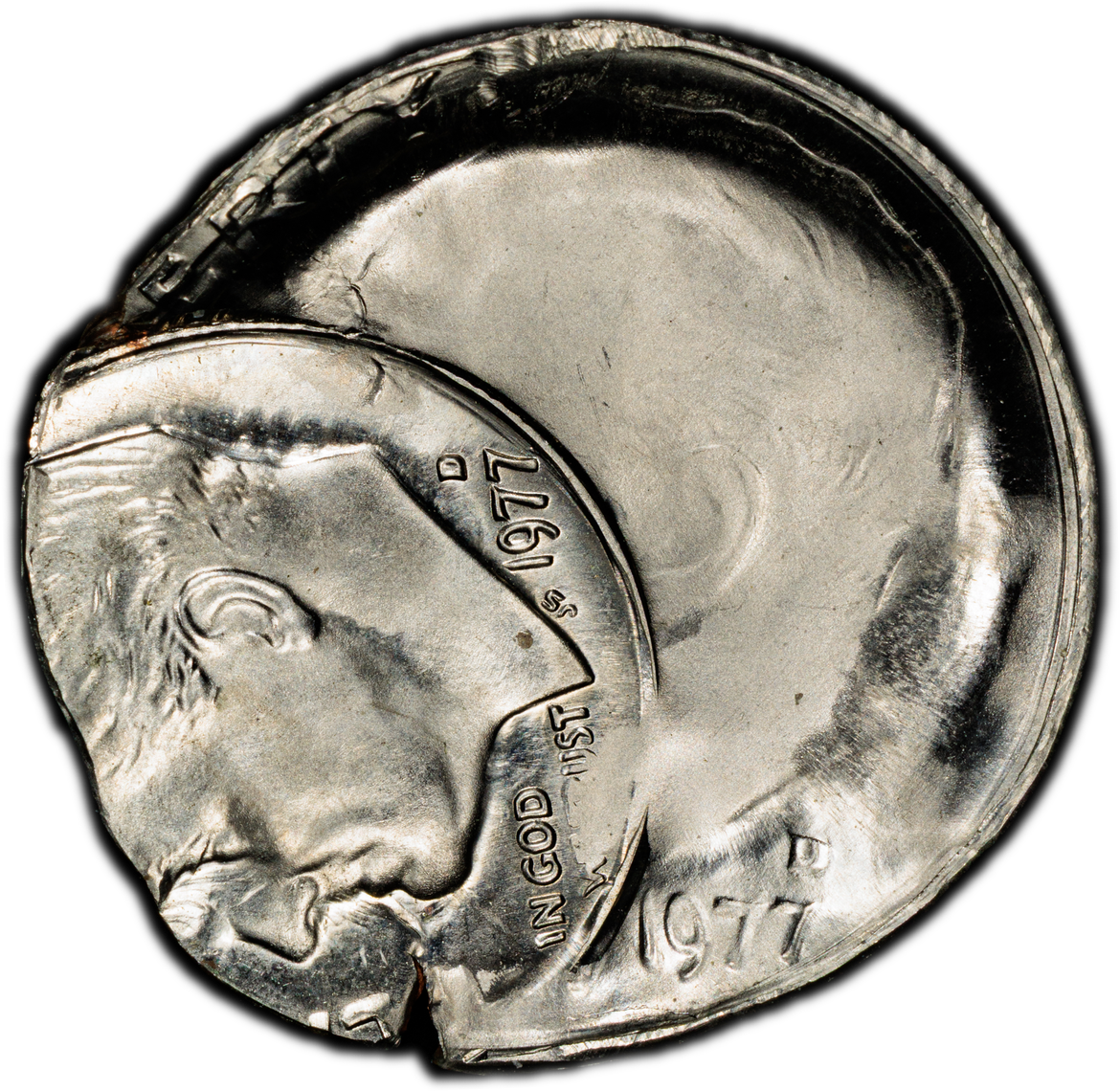
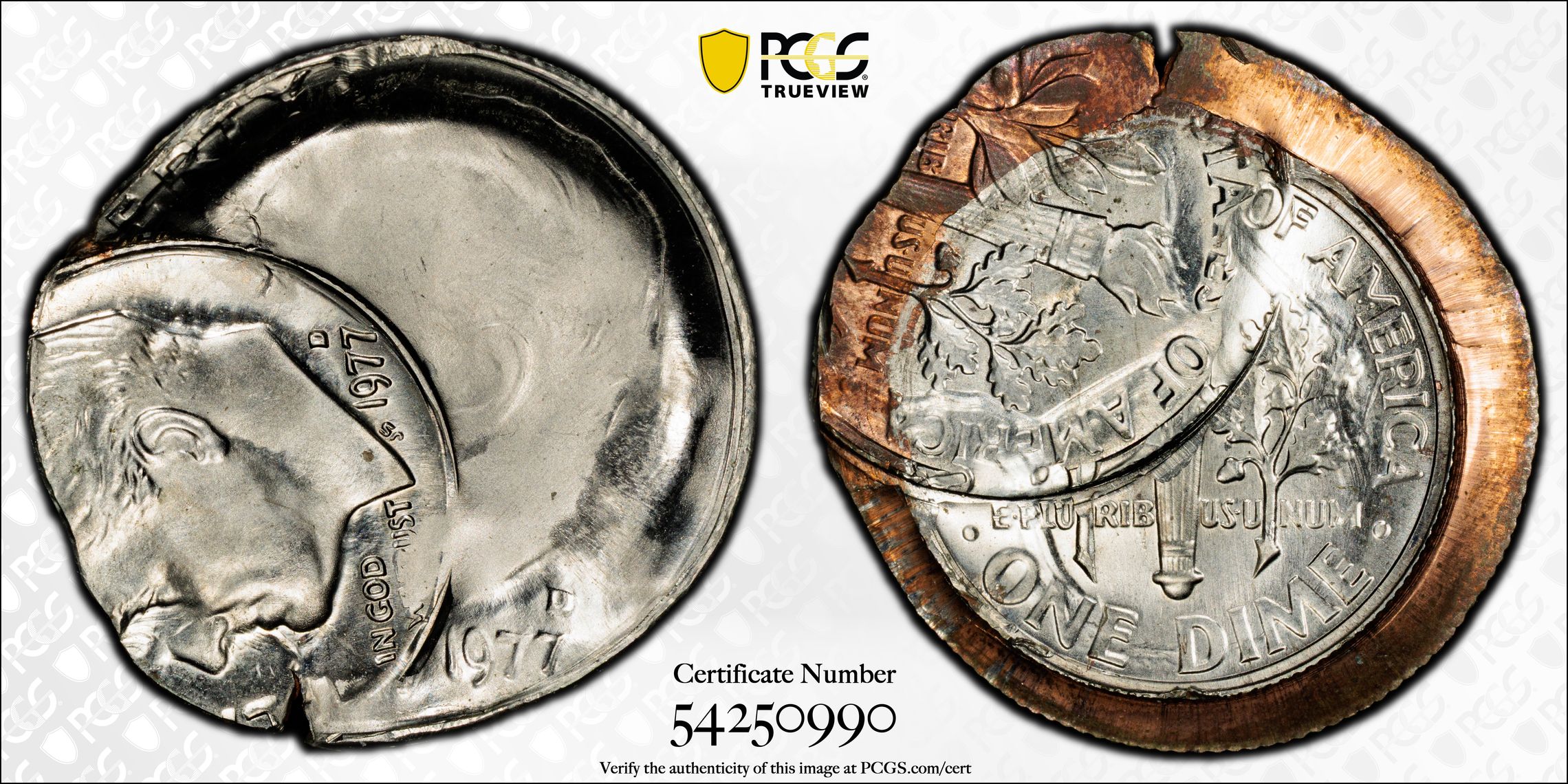
Here is a very dramatic and major dime error. Sizable errors such as this are not as often seen on dimes. This particular coin is the epitome of dramatic and it has tremendous eye appeal. In person, the coin is a screaming white gem. Online, you don't get the sense of how much this coin jumps out at the viewer. It certainly did for me. Let's dive into what happened here to create this piece.
This is a 1977-D dime that has been struck multiple times. In addition, there are other conditions in place that deserve examination. At first glance, the coin seems simply to be an expansive double strike, but there is more to it. I'll note that 1977-D is an unusual year for dramatic, major errors. There are other years and mints where major errors are - and I use this term a bit casually - more common. 1977 in Denver certainly isn't one of them. That immediately makes this coin rarer and more desirable, certainly than it would be if it was struck during a year where a larger number of major errors are known.
This coin is not just double struck. It is a multiple struck reverse die cap. The coin was struck once, normally and on center. It adhered to the reverse die and was struck a second time, and possibly a third. During that second or possibly third strike (it's nearly impossible to say how many times it might have been struck on center) another blank came between the obverse die and the obverse of this coin. That strike, with the planchet in the way, caused the massive expansion both of this error coin itself and of its obverse design that we see clearly here. It certainly looks like a counterbrockage, but a counterbrockage would require additional steps that did not happen in this case. For this to be a counterbrockage would have required a brockage coin to interface with an obverse die cap. There was no additional brockage coin or obverse die cap involved here.
On the reverse of this coin, we see that the primary centered initial strike is not expanded outward itself. The coin stayed adhered to the reverse die, and when it was struck that second or possibly third time it stayed in place. This kept all reverse details as they are after the coin was struck with the obverse obscured by that extra planchet.
The error was likely dislodged by that strike where the planchet obscured the image and for a brief moment was floating free within the striking chamber. The final strike, 50% off center, served to dislodge the coin fully from the striking chamber. We can see collar scarring along the circumference of that off center strike on the reverse.
All told, this is a dramatic and extremely exciting Roosevelt dime error, both by date, error type, condition, eye, appeal and rarity. It is fresh to market, and I jumped at the chance to purchase it because a coin like this comes along very rarely.
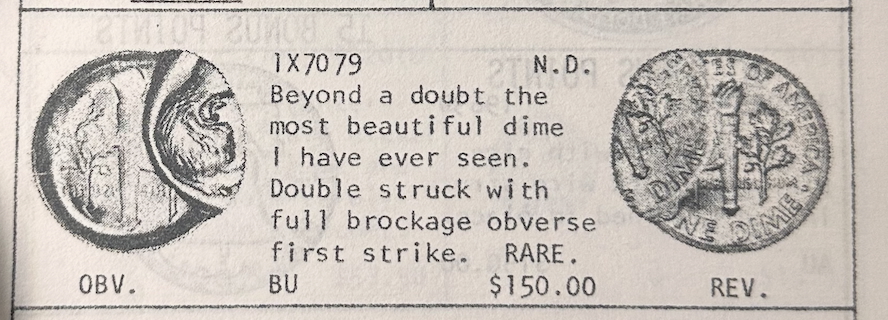
I own a double struck Roosevelt dime from the early 70s, which was struck as a first strike full reverse brockage and then struck a second time 50% off center, and die struck both sides. Lonesome John Devine, in the 1970s, called it "Beyond a doubt the most beautiful dime I have ever seen." I dare say that this current coin, although different by error type, pushes the limits of known and exciting Roosevelt dime errors. Lonesome John would have loved this coin as well had he known of it. It certainly vies with that earlier coin for the title of most beautiful dime error I have seen.
If you have questions about this piece, or would like to share exciting rarities of your own whether for sale or just for show, please be in touch anytime at minterrors@gmail.com.
Here is the double struck Roosevelt
dime that Lonesome John Devine called:
"Beyond a doubt the most
beautiful dime I have ever seen."
 |